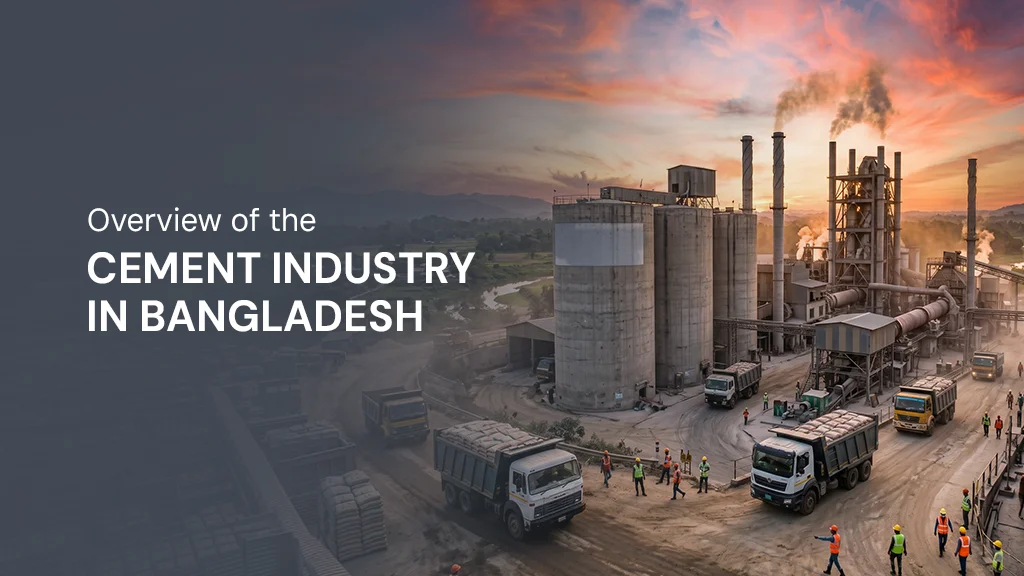
Bangladesh’s cement industry has gone from near-total import dependence to one of South Asia’s most dynamic manufacturing sectors in just three decades!
Today, it sits at the heart of the country’s construction economy, supplying materials for everything from family homes to metro rail infrastructure. The numbers behind this transformation are striking, and the story is still being written.
In this guide, we cover the key drivers, market figures, and industry dynamics that every construction professional and investor in Bangladesh should understand.
Understanding how this industry works, where it stands, and where it is headed is essential for anyone involved in construction, investment, or policy in Bangladesh.
The Historical Growth of Bangladesh’s Cement Industry
The journey of Bangladesh’s cement industry is genuinely remarkable. What began as a heavily import-reliant sector in the 80s has transformed into a domestically driven manufacturing force with over 41 registered factories and a combined annual production capacity of 86.02 million metric tons.
Think about this: In 1999, per capita cement consumption in Bangladesh was only 22 kg per year. By the 2020s, domestic demand had crossed 38 million metric tons annually. That is not just growth. That is an industry that rebuilt itself from the ground up.
From Import Dependence to Domestic Manufacturing
Historically, Bangladesh did not depend much on cement and lacked sufficient natural resources for manufacturing it. Base materials used in traditional construction required very little cement at all.
The shift happened gradually as urbanization accelerated through the 1990s and early 2000s. New grinding plants were established around Dhaka, Chittagong, and Mongla, using imported clinker as the primary input. By 2010, the number of operational manufacturers had reached around 30 companies.
Growth Milestones Over the Past Decade
Aggregate cement demand grew from 20 million metric tons per annum in 2014 to 38 million metric tons in 2024, representing an annual growth rate of 6.74%.
Rising incomes, urbanization, industrialization, and large investments in infrastructure projects drove this growth.
That decade of expansion brought new plants, better technology, and a wider range of cement products to the market.
Current Market Size and Economic Significance
Here is where things get interesting. Bangladesh’s cement sector is not just a construction input supplier. It is a full-fledged economic pillar with billions of dollars at stake.
In 2024, the total market value of the cement industry stood at approximately USD 4.47 billion, with a projected annual growth rate of 3.5%, bringing the industry’s valuation to USD 4.63 billion by 2025. Looking ahead, the market is expected to expand further, reaching USD 5.33 billion by 2028.
Production Capacity vs. Actual Demand
You might be wondering whether the industry is truly healthy if production so far outstrips demand. The answer is nuanced.
The cement industry in Bangladesh operates at more than double its current demand capacity. This overproduction has led to price wars, squeezing profit margins, particularly for small and mid-sized manufacturers.
According to the Bangladesh Cement Manufacturers Association, the country has 41 cement factories with a combined production capacity of 8.4 million metric tons per month.
However, sales dropped to just 3.4 million metric tons per month, representing approximately 45% of the industry’s capacity.
Here is a quick snapshot of key market figures:
| Indicator | Value |
| Market Value (2024) | USD 4.47 billion |
| Projected Market Value (2028) | USD 5.33 billion |
| Annual Demand (2024) | ~38 million metric tons |
| Total Production Capacity | ~100 million metric tons per year |
| Number of Factories | 41 registered |
| Capacity Utilization Rate (2024) | ~45% |
| CAGR Forecast (2024-2028) | 3.6% |
Contribution to the National Economy
With Bangladesh having an estimated GDP size of USD 420 billion, a population of 170 million, and an urbanization rate of only 32%, there is significant potential for the cement industry to grow further in the future.
The industry directly employs thousands of workers and sustains a wide supply chain covering logistics, raw material handling, packaging, and retail distribution.
Raw Materials and Supply Chain Structure
Now let’s get real about one of the sector’s most persistent vulnerabilities.
Bangladesh’s cement industry does not produce its own clinker at any significant scale. That single dependency shapes everything from pricing to supply chain risk.
The cement sector is heavily dependent on imports, with over 85% of raw materials sourced from countries including Thailand, Indonesia, the UAE, India, Pakistan, Oman, China, Vietnam, and Japan.
How Cement Is Produced in Bangladesh
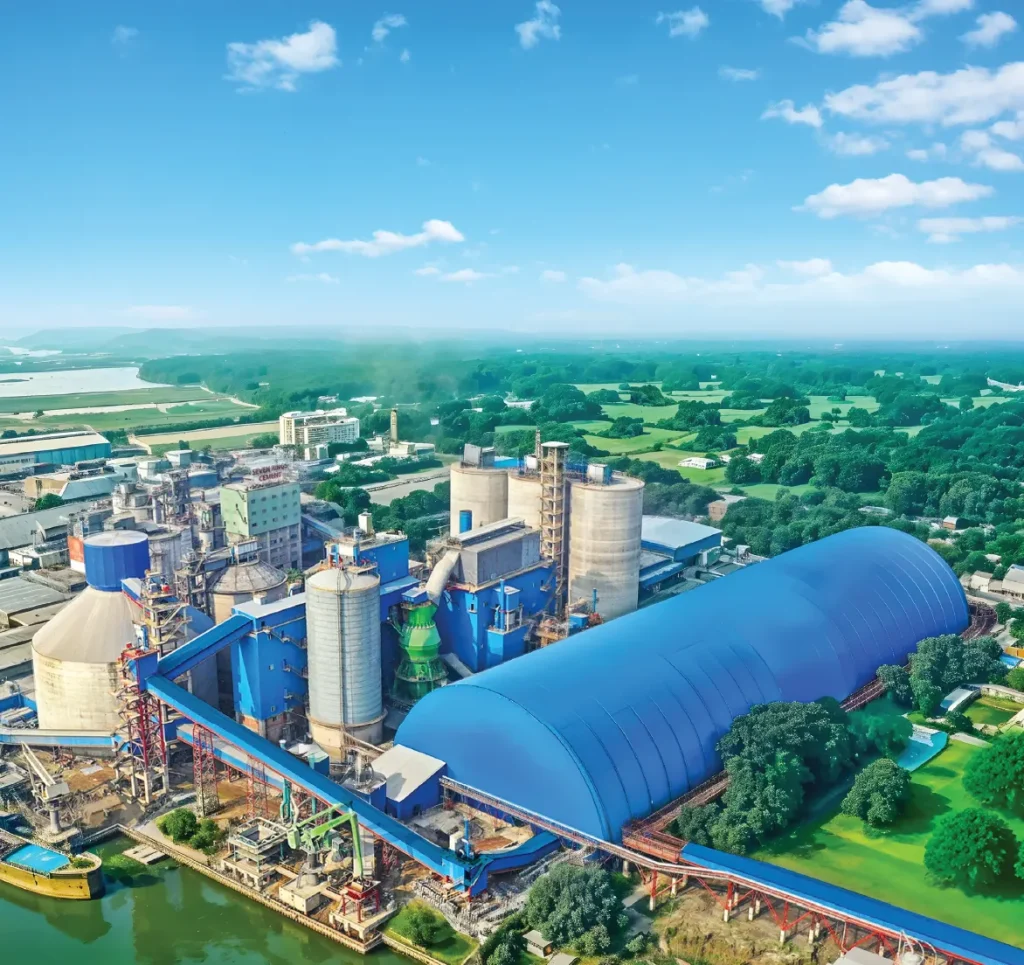
Cement production in Bangladesh primarily involves grinding raw materials such as clinker, gypsum, limestone, slag, and fly ash.
Most manufacturers operate grinding units rather than fully integrated plants, which means they import clinker and blend it with supplementary materials locally.
This grinding-only model keeps capital costs lower, but it also makes the entire industry vulnerable to global clinker price movements and foreign exchange availability.
Clinker Import Dependency and Its Risks
Bangladesh relies heavily on imported clinker, slag, and gypsum, primarily from Vietnam, India, and the UAE.
Foreign exchange constraints in 2023-2024 led to delays in Letter of Credit approvals, disrupting supply chains and creating spot shortages.
In 2024 alone, the cement industry imported clinker valued at approximately USD 877 million.
Blended Cement as a Strategic Response
To reduce import reliance, producers are scaling up the use of slag, fly ash, and limestone filler in their blended cement offerings. Government bodies have begun specifying low-clinker cement in select public procurement contracts under revised PWD standards.
This is a smart shift, and one that is gaining real momentum across the industry.
Major Players in Bangladesh’s Cement Market
Let’s break it down in terms of who actually controls this market. The competitive landscape includes both domestic giants and international operators.
Key Companies and Their Positioning
| Company | Notable Strength |
| Seven Rings Cement | 8.4 million MT annual capacity, three plants, VRM technology |
| Shah Cement (Abul Khair Group) | Large production volume, wide distribution network |
| Lafarge Holcim Bangladesh | Integrated plant, international operations |
| Premier Cement Mills | Infrastructure project focus |
| Tiger Cement (Western Group) | Significant grinding capacity |
| Meghna Cement | Regional distribution presence |
Challenges Facing the Industry
On a more serious note, 2024 was genuinely difficult for Bangladesh’s cement sector. Multiple pressures hit simultaneously, and the effects were felt across the entire value chain.
The sector attributed this downturn to political instability, rising production costs, and delays in government infrastructure projects, leaving the industry using less than half of its capacity.
Rising Production Costs
The cost of clinker, which constitutes 60-65% of cement production costs, rose sharply in 2024 due to global supply chain disruptions.
Energy expenses also escalated, with electricity and fuel prices increasing by 15-20% year-on-year, impacting production costs.
A weakening Bangladeshi Taka led to increased costs for imported raw materials such as clinker, gypsum, and fly ash.
Overcapacity and Margin Pressure
Have you thought about what happens when an industry produces twice what the market needs?
Price competition becomes brutal.
Smaller manufacturers with less efficient operations cannot absorb the margin pressure, and consolidation becomes inevitable.
Declining Export Revenue
Bangladesh experienced a 27.3% year-on-year drop in cement export revenue to USD 7.71 million in the first seven months of FY 2024-25, compared to USD 10.61 million in the same period of the previous year.
Growth Drivers and Future Opportunities
Despite the headwinds of 2024, the structural case for long-term growth in Bangladesh’s cement industry remains solid.
Due to the rapid pace of urbanization, industrialization, large-scale infrastructural development, and government projects, as well as the construction of commercial and residential buildings, demand for cement has markedly increased, and the growth is expected to continue into the future.
Urbanization and Housing Demand
With Bangladesh’s urbanization rate at only 32%, there is significant potential for the cement industry to grow further. As more people move into cities, demand for housing, commercial space, and urban infrastructure follows directly.
Government Infrastructure Investment
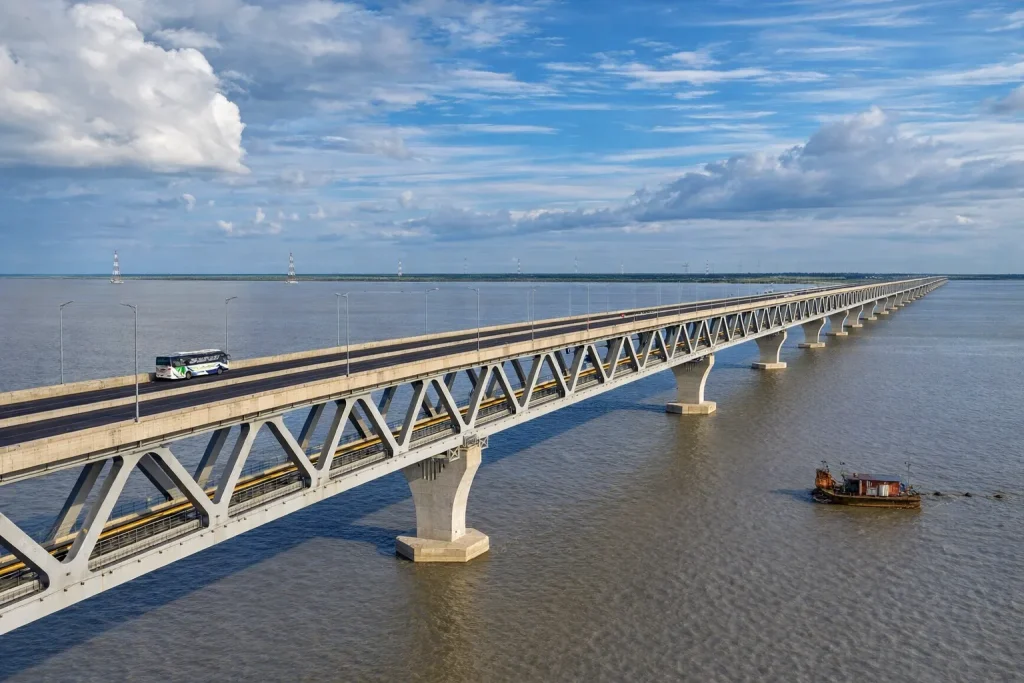
Bangladesh invests heavily in infrastructure development, particularly power generation, highway construction, and bridge building. The cement industry has the potential to play a significant role in Bangladesh’s goal of becoming a developed country by 2041.
There is a positive link between GDP growth and the cement industry. If GDP growth is 6%, the cement industry growth is approximately 9%. At 7% GDP growth, the cement industry grows at approximately 10%.
Green Cement and Sustainable Production
The government’s push for green building standards and localized industrial inputs is prompting shifts in sourcing and formulation strategies.
Long-term competitiveness will depend on strategic capital expenditure, currency risk mitigation, and innovation in sustainable cement products.
Firms that invest in renewable energy integration and digital process control today will be the ones with margin advantages tomorrow.
Market Forecast to 2029
The cement market in Bangladesh recorded a CAGR of 4.9% during 2020-2024. Growth momentum is expected to remain positive, with the market projected to expand at a CAGR of 4.3% during 2025-2029.
Regulatory Environment and Taxation
Understanding the rules of the road matters as much as knowing the market size. Bangladesh’s cement sector operates under a regulatory framework that directly affects production economics.
BSTI Certification Requirements
The Bangladesh Standards and Testing Institution sets and enforces quality standards for all cement sold domestically. Every manufacturer must hold a valid BSTI license, and products must meet defined compressive strength, fineness, and soundness benchmarks.
Import Duties and Tax Structure
The import duty on clinker in Bangladesh was increased from BDT 500 to BDT 700 per tonne in 2024, aimed at encouraging domestic clinker production. The standard corporate tax rate for cement manufacturers stands at 27.5%, and a standard 15% VAT applies to cement sales.
The duty increase on clinker is a signal that the government wants to reduce import dependency over time, even if the domestic clinker production infrastructure is not yet ready to absorb that shift.
Seven Rings Cement: Building Bangladesh From the Ground Up
When you look at the brands that have genuinely shaped Bangladesh’s construction landscape, Seven Rings Cement stands out for more than just market presence. It combines production scale, technology, and a proven project track record that few competitors can match.
Scale, Reach, and Manufacturing Strength
Seven Rings Cement began its journey in Bangladesh in 1991 and has since expanded across three plants in Gazipur, Khulna, and Chattogram, reaching an annual installed production capacity of 8.4 million metric tons.
The brand is sold in 80% of all cement-related outlets and distributed directly to 90% of all districts across Bangladesh, supported by a fleet of 222 vehicles serving 8,000 retail locations.
That kind of distribution consistency matters enormously on large projects where supply disruptions can stall construction timelines.
Products Built for Bangladesh’s Conditions
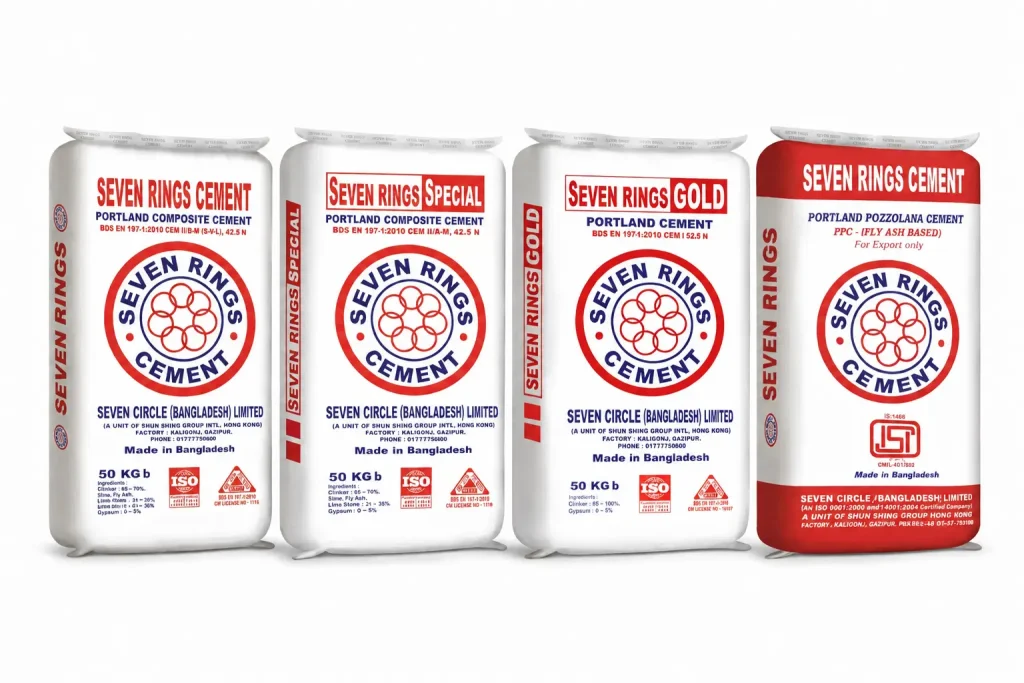
Seven Rings Cement offers four distinct products covering the full range of construction demands, from general residential work to pre-stressed infrastructure.
| Product | Standard | Best Application |
| Seven Rings Cement | CEM II/B-M | Residential and general construction |
| Seven Rings Special | CEM II/A-M | High-rise RCC, columns, heavy slabs |
| Seven Rings Gold | CEM I | High-strength concrete, Bridges, pre-stressed concrete, fast-track projects |
| Seven Rings (PPC) | IS 1489 Part 1: 2015 | Mass concrete, long-term durability |
Proven on Bangladesh’s Biggest Projects
Seven Rings Cement delivered more than 0.370 million tons of cement to a single project, the highest quantity ever supplied by any cement manufacturer to a single project in the history of Bangladesh.
The brand has also supplied materials to the Hazrat Shahjalal International Airport Third Terminal and the Moghbazar-Mouchak Flyover, projects where material reliability is non-negotiable.
Seven Rings Cement won the Green Factory Award 2025, the only cement company in Bangladesh to receive this recognition that year. It is a fitting reflection of a brand that takes both structural performance and environmental responsibility seriously.
Conclusion
The cement industry in Bangladesh is one of the country’s most consequential sectors, built on decades of investment, expansion, and competitive pressure.
It has grown from near-zero domestic production to a capacity that far exceeds current demand, and it faces real structural challenges around clinker dependency, currency pressure, and overcapacity.
At the same time, the long-term growth story is intact. Urbanization, government infrastructure investment, and rising per capita income all point toward sustained demand growth through 2030 and beyond.
The industry players that invest in operational efficiency, sustainable production, and supply chain resilience will define the next chapter of this sector.
For contractors, investors, engineers, and policymakers alike, understanding this industry is not optional.
Cement is the material foundation of Bangladesh’s development ambition, and the decisions made inside this sector will shape the built environment for generations.
Frequently Asked Questions (FAQs)
1. How large is Bangladesh’s cement industry by market value?
The cement industry in Bangladesh was valued at approximately USD 4.47 billion in 2023 and is projected to reach USD 5.33 billion by 2028, growing at a CAGR of around 3.6%.
2. How many cement factories are currently operating in Bangladesh?
There are 41 registered cement factories in Bangladesh with a combined monthly production capacity of 8.4 million metric tons, though actual utilization in 2024 was approximately 45% of that capacity.
3. Why does Bangladesh import so much clinker for cement production? Bangladesh does not have significant domestic limestone reserves suitable for large-scale clinker production. Over 85% of raw materials, including clinker, gypsum, and slag, are imported from countries like Vietnam, India, and the UAE.
4. What caused the cement industry’s poor performance in 2024?
Political instability, suspension of major government infrastructure projects, rising production costs, currency depreciation, and foreign exchange constraints on raw material imports all contributed to a significant sales contraction in 2024.
5. What is the per capita cement consumption in Bangladesh?
Per capita cement consumption has grown significantly from just 22 kg per year in 1999. Bangladesh still has relatively low per capita consumption compared to regional peers, which indicates substantial room for growth as urbanization continues.
6. What is the relationship between GDP growth and cement demand in Bangladesh?
Research shows a consistent multiplier effect. For every 1% of GDP growth, cement industry growth runs at approximately 1.4 to 1.5 times that rate. At 7% GDP growth, the cement sector tends to expand by around 10%.
7. Is Bangladesh self-sufficient in cement production?
Bangladesh is self-sufficient in terms of grinding and blending capacity, producing enough to meet domestic demand. However, it is not self-sufficient in raw material terms, as the vast majority of clinker is still imported.
8. What is green cement, and is it available in Bangladesh?
Green cement refers to cement produced with lower carbon emissions, often using supplementary cementitious materials like fly ash, slag, and calcined clay in place of high-clinker OPC. The segment is growing in Bangladesh as government procurement standards begin favoring low-clinker formulations.
9. What is the long-term growth outlook for Bangladesh’s cement industry?
The market is projected to grow at a CAGR of 4.3% through 2029, driven by urbanization, housing demand, and continued government infrastructure investment under Vision 2041. Firms that reduce clinker import exposure and adopt sustainable production methods are best positioned for that growth.

