Building a home in Bangladesh is rarely just a construction project. For most families, it is years of savings, careful planning, and a decision that shapes the next generation!
And yet, one of the most consequential choices in that entire process gets made quickly, sometimes at a hardware store, sometimes on a contractor’s recommendation: which cement to use.
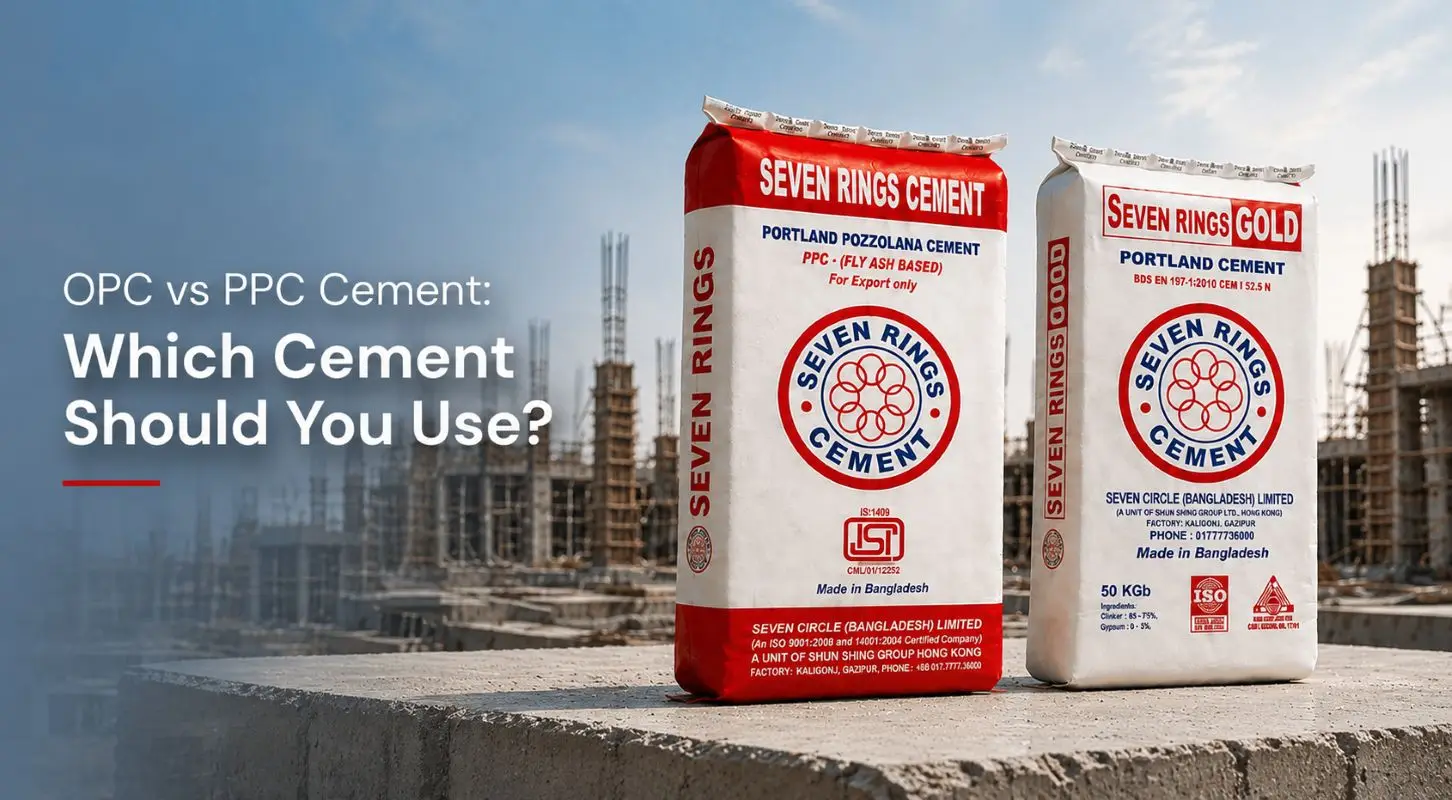
The two cement types you will encounter most often in Bangladesh are OPC (Ordinary Portland Cement) and PPC (Portland Pozzolana Cement).
They are not interchangeable. Each has distinct strengths, limitations, and applications where it outperforms the other.
In this guide, we will break down both types of cement clearly, with real data and practical guidance for Bangladesh’s specific construction conditions. By the end, you will know exactly which cement belongs to which part of your project.
What Is OPC Cement?
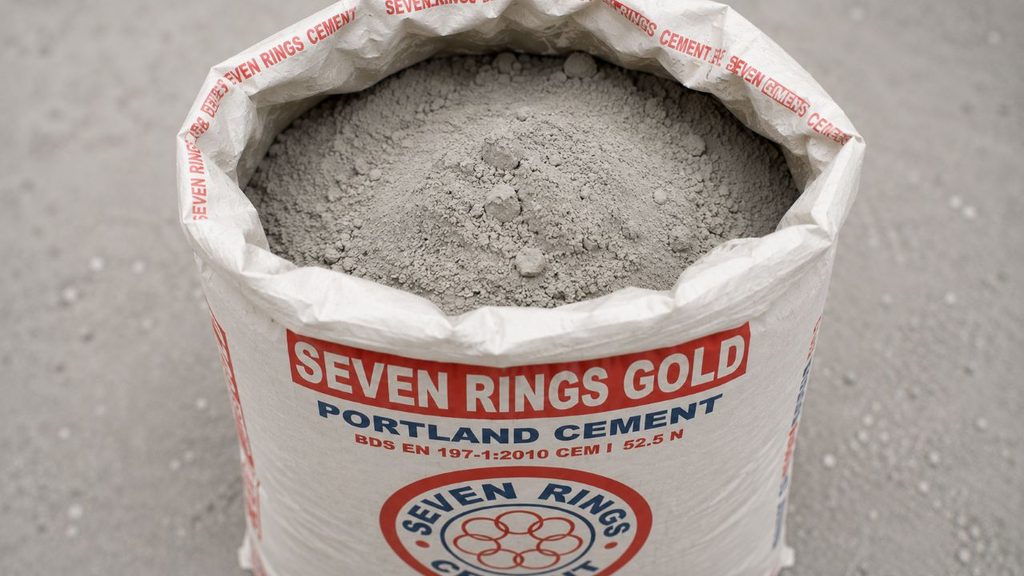
Ordinary Portland Cement, or OPC, is manufactured by heating limestone and clay in a kiln at approximately 1,450°C to form clinker, then grinding it with gypsum. It is the most widely used cement in the world and has been a construction staple for over a century.
Composition and Grades of OPC
OPC contains around 95% clinker and 5% gypsum. That high clinker content drives its defining characteristic: rapid early strength gain.
It comes in three standard grades:
- OPC 33 Grade — Compressive strength of 33 MPa at 28 days
- OPC 43 Grade — Compressive strength of 43 MPa at 28 days
- OPC 53 Grade — Compressive strength of 53 MPa at 28 days
When a contractor specifies OPC 53 Grade, it refers to cement that achieves a minimum standardized compressive strength of 53 MPa at 28 days. However, the final strength of a concrete column depends on the complete concrete mix design and construction quality—not on the cement grade alone.
What Is PPC Cement?
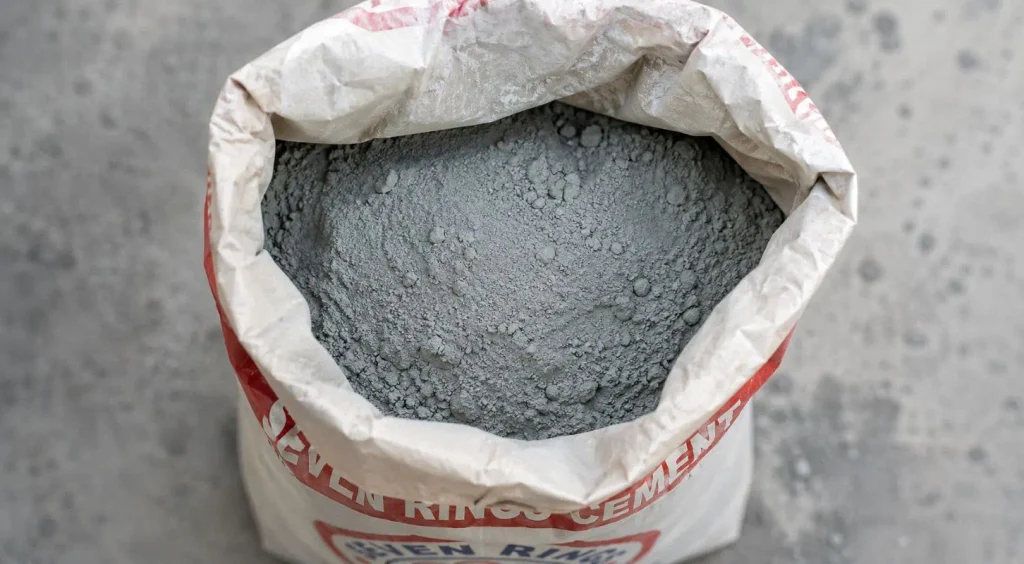
Portland Pozzolana Cement, or PPC, is a blended cement that combines OPC clinker with pozzolanic materials such as fly ash, volcanic ash, or silica fumes. The fly ash used is typically recovered from coal-fired power plants, making PPC a more environmentally responsible choice by design.
Composition of PPC
A standard PPC mix contains:
- 65–70% Portland clinker
- 25–30% pozzolanic material (primarily fly ash)
- 3–6% gypsum
Fly ash particles are generally spherical, and their shape can create a lubricating or “ball-bearing” effect in the mix. This physical property improves workability and gives PPC a smoother consistency during application, something plasterers and masons notice immediately on the job.
OPC vs PPC: A Full Comparison
| Property | OPC | PPC |
| Clinker Content | ~95% | 65–70% |
| Initial Setting Time | 30 minutes | 30 minutes |
| Final Setting Time | ~280 minutes | ~600 minutes |
| Early Strength (7 days) | Higher | Lower |
| Long-term Strength (28+ days) | High | Equal or Higher |
| Heat of Hydration | Higher (~370–525 kJ/kg) | Lower (~210–315 kJ/kg) |
| Sulphate Resistance | Lower | Higher |
| Water Resistance | Moderate | Higher |
| Workability | Good | Better |
| Cost | Higher | Lower |
| CO₂ Footprint | Higher | Lower by up to 22% |
| Ideal Use | RCC, structural work | Masonry, plastering, and coastal structures |
Key Differences Between OPC and PPC Cement
You might be wondering: if both cements share the same clinker base, what actually separates their real-world performance?
The answer lies in how each cement behaves during and after hydration.
Strength Development
OPC gains strength fast. In the first 3 to 7 days, its high clinker content drives rapid compressive strength development. This matters on projects where formwork must be removed early or construction timelines are tight.
PPC starts slower. But the pozzolanic reaction continues for months as fly ash reacts with calcium hydroxide released during hydration.
Research published in peer-reviewed studies shows that at 28 days, OPC achieved a compressive strength of 41 MPa, exceeding PPC by 21% in early tests.
However, strength development depends on the specific cement and concrete mix. PPC may continue gaining strength beyond 28 days and, under suitable mix and curing conditions, can eventually match or exceed comparable OPC concrete at later ages.
Heat of Hydration
This is one of the most overlooked differences until cracks appear on site.
When cement reacts with water, it generates heat. The same research found that OPC reached a peak hydration temperature of 38°C with 137J of heat liberation, compared to PPC’s 33°C and 122J.
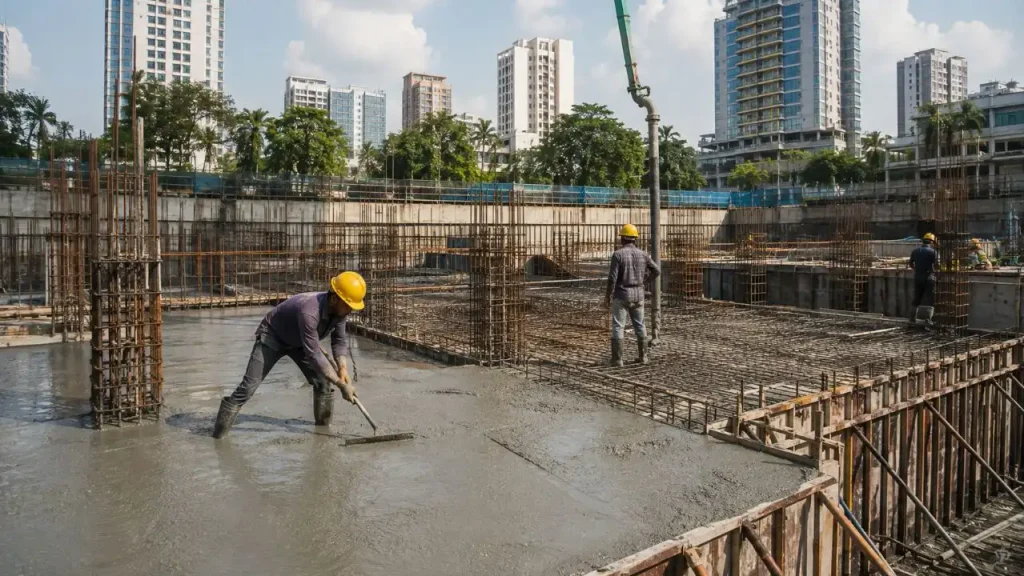
In large pours like raft foundations or retaining walls, that difference in heat buildup creates temperature differentials between the concrete core and surface. The result is thermal cracking that weakens the structure from within.
In Bangladesh’s already high ambient temperatures, this risk is amplified. PPC’s lower heat of hydration makes it a significantly safer choice for mass concreting.
Durability and Chemical Resistance
PPC develops a denser, less porous microstructure over time through its pozzolanic reaction. This makes PPC concretely more resistant to:
- Sulfate attacks are common in floodplain and delta soils
- Chloride penetration from saline groundwater and coastal air
- Water seepage and long-term moisture damage
For Bangladesh, where large portions of the country sit on coastal belts, river flood plains, and high-humidity zones, this chemical resistance is a practical necessity.
Environmental Impact
OPC production is clinker-heavy and energy-intensive. The global cement industry accounts for approximately 7% of global CO₂ emissions, with OPC as the primary driver.
Replacing OPC with fly ash-blended PPC can reduce CO₂ emissions by 8.84 to 22.10%, depending on the replacement level. For any project with sustainability targets, that margin is meaningful.
Where Should You Use OPC Cement?
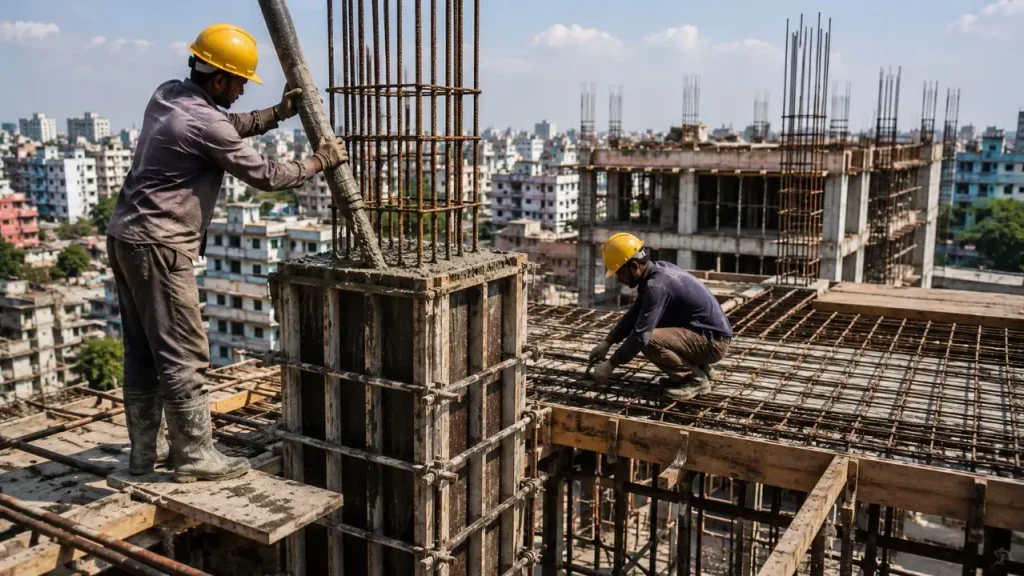
OPC is the right choice when early compressive strength and construction speed are the top priorities.
Best Applications for OPC
- Reinforced Cement Concrete (RCC) work: slabs, beams, columns, and structural foundations
- Precast concrete products requiring rapid demolding
- Fast-track construction where formwork removal timelines are tight
- Bridges, flyovers, and high-load industrial structures
- Dry climatic conditions without sustained moisture exposure
Where Should You Use PPC Cement?
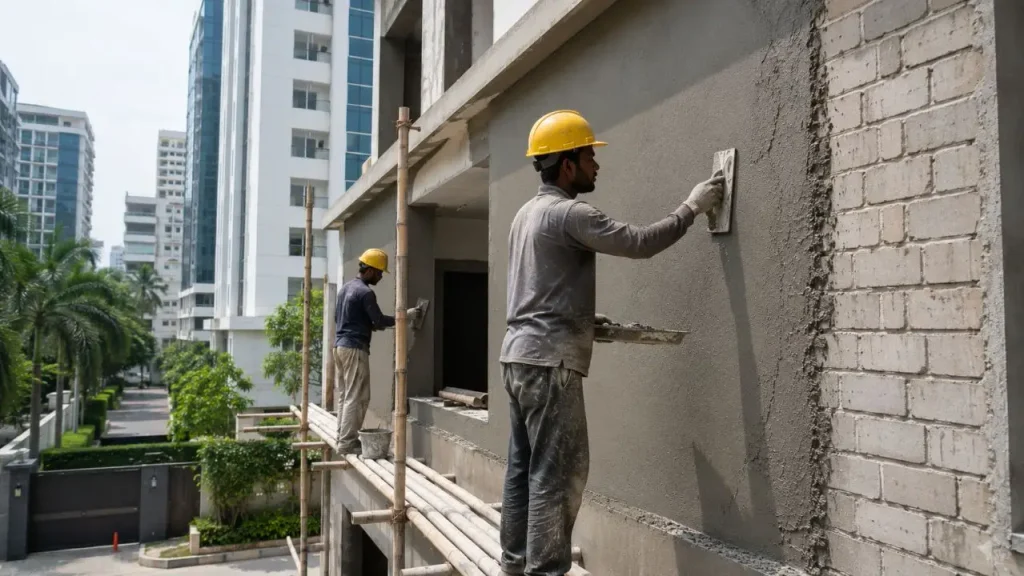
PPC is the better choice when long-term durability, chemical resistance, and cost-efficiency are the priorities.
Best Applications for PPC
- Residential construction: walls, masonry, plastering, and tiling
- Waterproofing work in basements, bathrooms, and terraces
- Coastal and saline-zone structures where chloride resistance is critical
- Mass concrete pours, such as raft foundations and dykes
- Foundation work in sulfate-rich delta soils
- General-purpose construction where early strength is not the overriding demand
A scenario that plays out frequently across Bangladesh: a homeowner builds in Khulna or Barisal near water. Using OPC for external plaster seems fine at first, but within two to three years, saline air and ground moisture begin degrading the surface.
A contractor who understands cement would have specified PPC from the start.
How to Choose the Right Cement Brand in Bangladesh
Understanding OPC and PPC is one thing. Translating that into a brand decision in Bangladesh is another challenge entirely. With dozens of brands on shelves, how do you verify the cement you are buying actually performs to its label?
A few things are worth checking before committing to any brand on a large project. Does the manufacturer maintain consistent raw material sourcing? Does their grinding process control particle fineness uniformly across batches? Has their product been verified under real project conditions, not just a controlled lab test?
How Seven Rings Cement Addresses Both OPC and PPC Needs
Seven Rings Cement has been operating in Bangladesh since 1991. Rather than offering a single product for all applications, the brand maintains distinct variants that map directly to the OPC and PPC use cases above.
For OPC-type performance, Seven Rings Gold (CEM I) is the relevant product. It contains 95–100% clinker with 0–5% gypsum, sourced from manufacturers in Thailand, Indonesia, Vietnam, and the UAE, with natural gypsum from quarries in the UAE and Oman.
Consistent upstream sourcing translates into predictable strength performance in the field.
For PPC-type and blended-category performance, Seven Rings offers two options. The standard Seven Rings Cement (CEM II/B-M) blends clinker with slag, fly ash, and limestone for general residential and commercial use.
Seven Rings Special (CEM II/A-M) carries a higher clinker ratio within the blended category, making it suitable for mid-to-high-rise RCC work where blended cement is preferred but structural demands are higher.
Seven Rings also produces a pozzolana portland cement built to export-grade standards, the Seven Rings Cement PPC. It is a strong choice for contractors who require internationally benchmarked PPC performance on local or cross-border projects.
Both variants are processed through a Vertical Roller Mill (VRM), which produces finer, more uniform particles than conventional ball mill systems, an advantage that directly improves workability and long-term impermeability.
Have you thought about what particle fineness means on an actual construction site? A more uniformly ground cement fills microscopic voids more effectively during hydration.
In a country where rebar corrosion from moisture and chloride ingress is a leading cause of structural deterioration, that microstructural density makes a measurable difference over 15 to 20 years.
Where Each Product Fits the OPC vs PPC Framework
| Seven Rings Product | Cement Category | Best Use in Bangladesh |
| Seven Rings Gold (CEM I) | OPC-equivalent | Bridges, flyovers, pre-stressed structures, fast-track RCC |
| Seven Rings Special (CEM II/A-M) | Blended, higher clinker | High-rise columns, beams, and heavy slabs |
| Seven Rings Cement (CEM II/B-M) | Blended composite | General residential construction, masonry, ground slabs |
| Seven Rings Cement PPC (Export Based) | PPC-equivalent | Mass concrete, coastal structures, long-term residential |
Any brand can print technical specifications on a bag. What separates a reliable brand is whether those specifications hold up consistently across hundreds of thousands of bags under actual construction conditions.
Seven Rings Gold has been used across major infrastructure projects, including flyovers, railway bridges, and the Hazrat Shahjalal International Airport Third Terminal, a $1.8 billion project where Seven Rings delivered over 0.370 million tons of cement.
That figure represents the highest quantity ever supplied by a single cement manufacturer to a single project in Bangladesh’s history. That scale of deployment stress-tests batch consistency in a way no lab trial can replicate.
A Note on Environmental Responsibility
Seven Rings Cement received the Green Factory Award 2025, the only cement company in Bangladesh to earn this recognition that year. For most residential builders, this may feel like background information.
For developers working on projects with environmental compliance requirements, it is a concrete differentiator worth factoring into procurement decisions.
OPC vs PPC: Quick Decision Guide
Choose OPC if:
- Your project requires high early strength within the first 7 days
- You are working on RCC columns, beams, or fast-track structural elements
- Formwork removal on a compressed timeline is required
- The construction environment is dry with minimal moisture exposure
Choose PPC if:
- You are building in a humid, coastal, or chemically aggressive zone
- The work involves plastering, tiling, masonry, or waterproofing
- You are casting large volumes of concrete, such as raft foundations
- Long-term durability and lower cost are the primary targets
Final Thought
OPC and PPC are not competing products. They are complementary tools for different stages and conditions of construction. OPC delivers the early strength needed for structural speed. PPC delivers the durability needed for long-term performance, particularly in Bangladesh’s challenging coastal and humid environment.
Most experienced builders in Bangladesh use OPC for load-bearing structural elements and PPC for everything else. Getting that split right is not a minor technical detail. It is the difference between a structure that holds up for decades and one that demands costly repairs long before it should.
Choose the right cement for each application, cure properly, and build on a foundation that actually earns the trust placed in it.
Frequently Asked Questions (FAQs)
1. Which cement is better for home construction in Bangladesh, OPC or PPC? For most home construction, including walls, plastering, flooring, and tiling, PPC is the better choice. It offers stronger long-term durability, better chemical resistance, and lower cost. OPC is recommended specifically for structural RCC elements like columns, beams, and slabs, where early strength is the priority.
2. Is PPC cement as strong as OPC cement?
Yes, but the strength develops differently. At early ages, such as 7 days, OPC generally develops compressive strength faster than PPC because Portland cement hydration proceeds more rapidly.
However, the pozzolanic reaction in PPC continues for months, and PPC matches or exceeds OPC over longer curing periods. For most residential applications, the early strength gap is not structurally significant.
3. Why does PPC cement crack less than OPC?
PPC generates lower heat during hydration, reducing the risk of thermal cracking in large concrete pours. Its denser microstructure also limits shrinkage. In Bangladesh’s warm climate, where unmanaged heat during setting is a common cause of early surface cracking, this is a practical advantage on every pour.
4. Can OPC and PPC be used together on the same project?
Yes, and this is standard practice in Bangladesh. OPC is used for structural elements such as columns, beams, and slabs. PPC handles plastering, masonry, and waterproofing on the same build.
Using each cement for its intended application optimizes both performance and overall project cost.
5. Why is Seven Rings Cement recommended for projects in Bangladesh?
Seven Rings Cement offers a product range that directly covers both OPC-type and PPC-type requirements, processed through VRM grinding for consistent particle fineness.
Its track record includes the Hazrat Shahjalal Airport Third Terminal and Padma Multipurpose Bridge, and it holds the Green Factory Award 2025 as the only cement company in Bangladesh recognized that year.
The combination of technical consistency and verified field performance is what makes it a trusted name among engineers and contractors.

