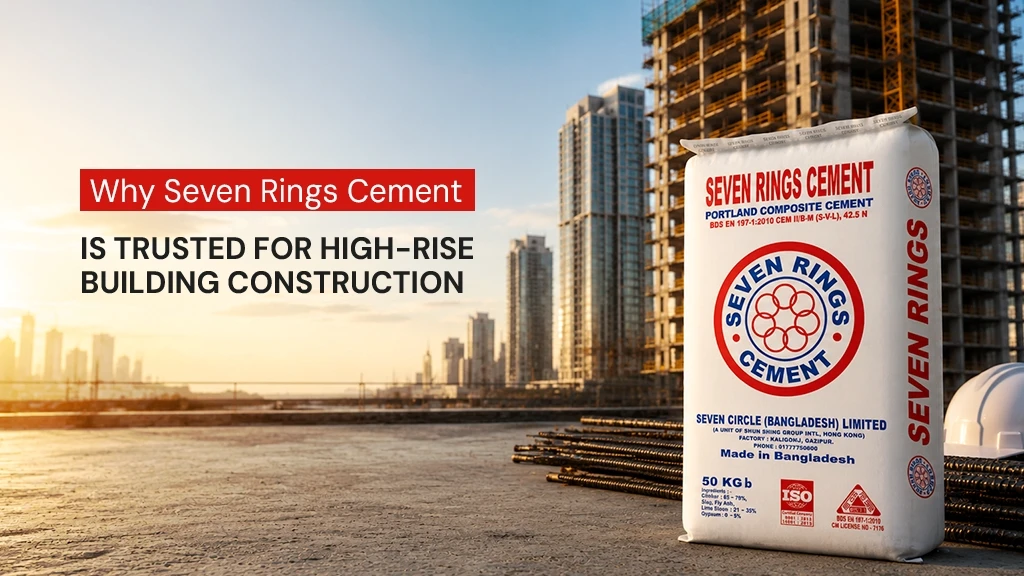
Walk through Dhaka today, and you will see it. Cranes over Uttara, scaffolding in Bashundhara, and old homes being replaced by ten-story buildings.
This is not just a trend. It is a response to the growing demand for urban housing.
Bangladesh’s urban housing deficit is projected to reach 8.5 million units by 2030, according to UN-Habitat. As cities become more densely populated and available land becomes increasingly limited, building upward is becoming an important part of addressing the country’s housing needs.
Bangladesh’s construction sector is also projected to grow, with a 2024 industry report forecasting a compound annual growth rate (CAGR) of 9.2% through 2028. However, taller buildings place greater demands on structural design, material selection, and construction quality.
For engineers, developers, and contractors building multi-story projects, cement is not merely a procurement decision. It is an important component of concrete performance and structural durability. Increasingly, the selection of a cement brand involves evaluating product specifications, manufacturing quality, supply reliability, and performance in demanding construction applications.
This is where Seven Rings Cement offers a range of products designed to meet different construction requirements.
What High-Rise Construction Actually Demands from Cement
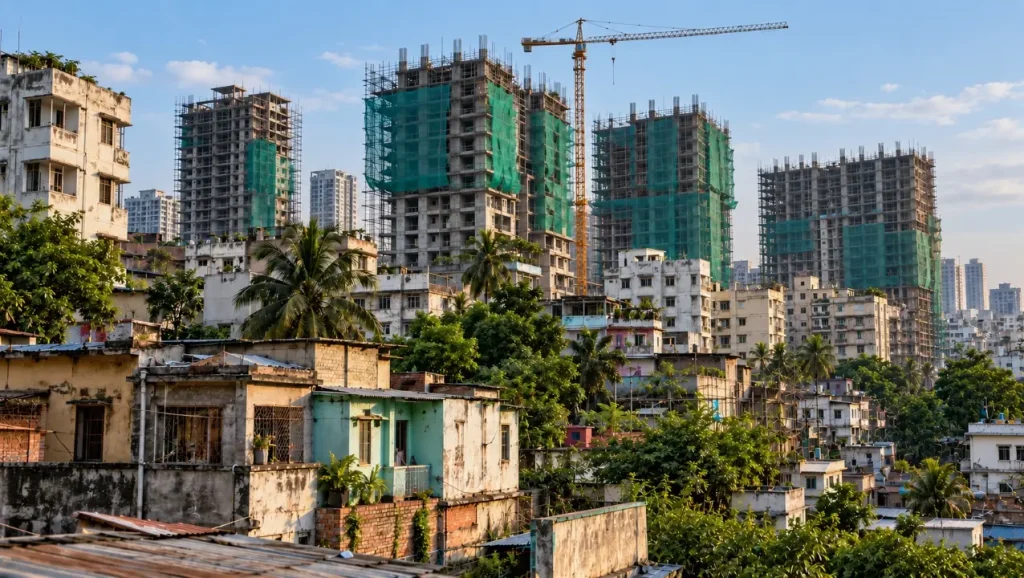
Before understanding why Seven Rings Cement is considered for tall structures, it helps to understand what cement does and what high-rise construction requires from it.
A multi-story reinforced concrete building places substantial demands on its structural system. As building height increases, the cumulative loads transferred through columns, beams, slabs, and structural cores become increasingly important.
The cement used in concrete for these elements must meet the specified performance requirements consistently throughout construction. Large projects may involve thousands of cubic meters of concrete placed over several months and under varying weather conditions.
Compressive Strength Under Cumulative Load
High-rise columns and structural cores can carry substantial compressive loads. In demanding applications, some tall buildings use concrete with compressive strengths of 15,000–20,000 psi, approximately 103–138 MPa. These are specialized applications rather than universal requirements for high-rise construction.
For many mid-rise buildings, concrete grades such as C30 to C40 may be specified, depending on structural design and loading requirements.
It is important to distinguish between cement strength and concrete strength. Cement contributes to the strength of concrete, but the final compressive strength also depends on the water-to-binder ratio, aggregate properties, mix proportions, admixtures, curing, and quality control.
For this reason, selecting cement for high-rise RCC work requires consideration of the specified concrete grade, the cement’s technical characteristics, and the performance of the complete concrete mix.
Pumpability Over Vertical Height
In tall buildings, concrete is often pumped vertically to elevated floors, sometimes exceeding 100 meters.
Reliable concrete pumping requires a properly designed mix that maintains workability and cohesion throughout the pumping process, without unacceptable segregation or blockage.
Cement characteristics influence concrete behaviour, but pumpability depends on the complete mix design, including aggregate grading, water-to-binder ratio, admixtures, and site conditions. Trial mixes and appropriate quality control are essential for reliable concrete placement at significant heights.
Thermal Management in Large Pours
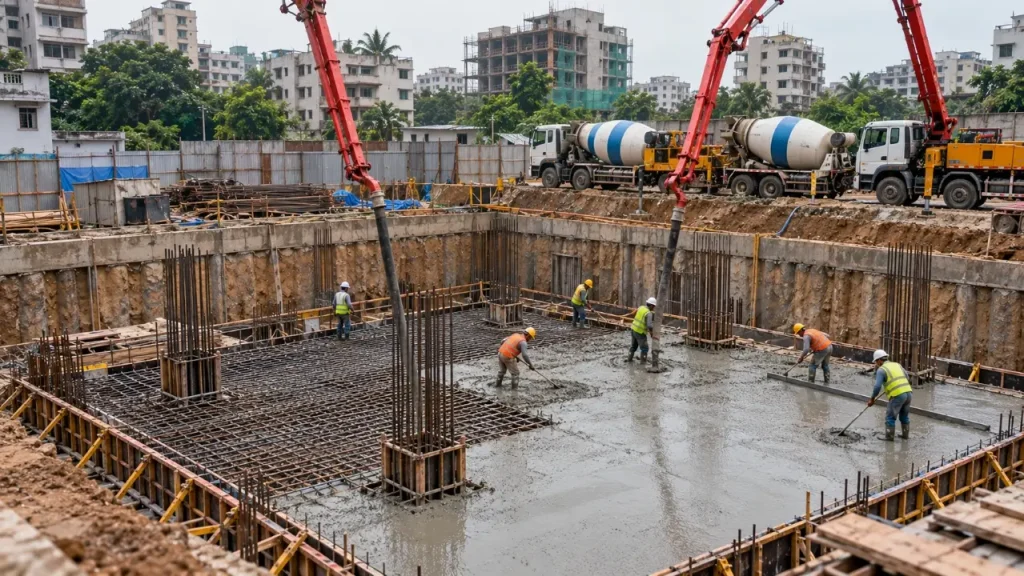
Raft foundations and transfer slabs in high-rise buildings may involve large-volume concrete pours. Cement hydration generates heat, and excessive temperature differences between the interior and surface of concrete can contribute to thermal cracking.
Managing heat generation and temperature differentials is therefore an important consideration in mass concrete construction.
Cement type, binder composition, mix proportions, placement sequence, curing, and temperature-control measures should be evaluated together to manage the risk of thermal cracking. The appropriate approach depends on the dimensions of the pour, the structural requirements, and the project’s environmental conditions.
Seven Rings Cement’s Full Product Range for High-Rise Applications
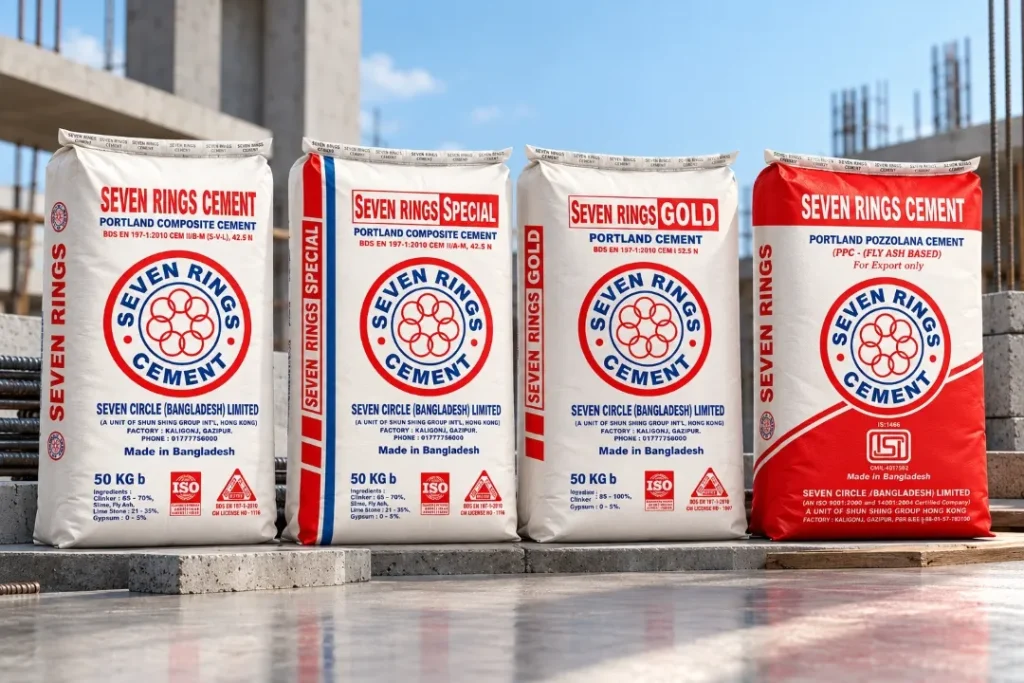
Seven Rings Cement offers different cement products designed for varying construction requirements. Its range includes three principal products for the Bangladesh market—Seven Rings Gold, Seven Rings Special, and Seven Rings Cement—as well as Seven Rings PPC, produced for the export market.
Each product has a distinct composition and technical classification. The appropriate choice depends on the intended application, the structural specifications, and the performance required from the concrete.
Seven Rings Gold (CEM I, 52.5N) — Maximum Early Strength
Seven Rings Gold is a Portland Cement containing 95–100% clinker and 0–5% gypsum. According to the manufacturer, its clinker is sourced from major manufacturers in Thailand, Indonesia, Vietnam, and the UAE, while natural gypsum is sourced from the UAE and Oman.
Clinker quality is an important factor in cement performance. Consistent raw-material sourcing, combined with manufacturing controls and quality testing, supports the production of cement that meets the specified technical requirements.
Seven Rings Gold is designed for applications requiring high early strength. Its applications include prestressed concrete structures and selected fast-track construction projects where early strength development is important.
In high-rise and infrastructure construction, potential applications include:
- Prestressed structural elements: Bridge girders, industrial beams, and other prestressed concrete components.
- Fast-track construction: Structural elements where early strength development supports planned construction schedules.
- High-rise and infrastructure projects: Applications where the cement’s specified performance meets the requirements of the structural design.
The product’s CEM I 52.5N classification identifies it as a high-strength-class Portland Cement under the applicable standard. However, the actual early and later-age strength of concrete depends on the mix design, curing conditions, and construction practices.
For projects requiring high early strength, Seven Rings Gold is an option to evaluate against the project’s technical specifications and verified concrete performance.
Seven Rings Special (CEM II/A-M, 42.5N) — High-Rise RCC Durability
Seven Rings Special is a Portland Composite Cement manufactured by inter-grinding Pulverized Fuel Ash (PFA), Blast Furnace Slag, and Limestone with clinker and gypsum.
Its published classification is CEM II/A-M (S-V-L), 42.5N, under BDS EN 197-1:2010. The manufacturer’s published composition specifies 80–94% clinker, 6–20% combined mineral components, and 0–5% gypsum.
Why consider composite cement for high-rise RCC construction rather than selecting cement solely on the basis of clinker content?
The answer lies in the balance between strength development, workability, heat generation, and long-term durability.
Composite cement and blended concrete mixtures have been used in major high-rise projects around the world. The Burj Khalifa, for example, incorporated fly ash in its concrete mix to achieve the performance required for its demanding structural applications. This illustrates the role supplementary cementitious materials can play in high-performance concrete.
In composite cement, suitable mineral components can contribute to long-term strength development and influence concrete permeability and durability. Actual results depend on the composition of the cement, the concrete mix, curing, and exposure conditions.
Seven Rings Special offers several potential benefits:
- Long-term strength development: Pozzolanic reactions can contribute to strength development over time under suitable curing conditions.
- Workability: Its composition can support concrete placement and compaction when the mix is properly designed.
- Surface finish: Appropriate mix design and placement can help achieve a smoother finish on concrete surfaces.
- Durability: A well-designed, adequately cured concrete mix can help limit moisture and chloride penetration.
- Heat management: Blended cement compositions can help manage heat generation compared with some ordinary Portland cement formulations.
For columns, beams, slabs, and other reinforced concrete elements in multi-story buildings, Seven Rings Special is a product to consider when its specifications meet the project’s concrete grade, durability requirements, and structural design.
The final cement selection should always be supported by the structural engineer’s specifications and suitable concrete mix trials.
Seven Rings Cement (CEM II/B-M, 42.5N) — General High-Rise Construction
Seven Rings Cement is a Portland Composite Cement made from clinker, gypsum, slag, fly ash, and limestone.
The CEM II/B-M (S-V-L), 42.5N classification places it under BDS EN 197-1:2010. According to the standard, the composition specifies 65–79% clinker, 21–35% combined mineral components, and 0–5% gypsum.
This product can be considered for a broad range of construction applications, including residential apartments, commercial buildings, mass concreting, and RCC structures.
In a typical high-rise project, applications may include:
- Residential and commercial building construction.
- RCC elements where the product meets the specified concrete performance requirements.
- Mass concrete applications where heat generation is an important consideration.
- Submerged and underground structures, subject to the project’s exposure conditions and durability specifications.
- Architectural and decorative concrete applications where the required finish can be achieved through appropriate mix design and workmanship.
Its blended composition can support workability and long-term strength development. It may also help reduce heat generation compared with some ordinary Portland cement formulations, depending on the materials and mix proportions.
Seven Rings Cement therefore provides an option for general construction volumes where its technical characteristics, strength class, and durability performance meet the project’s requirements.
Seven Rings PPC (IS 1489 Part 1:2015) — Export Product for Specified Applications
Seven Rings PPC is a Portland Pozzolana Cement produced in accordance with Indian Standard IS 1489 (Part 1):2015.
This product is produced specifically for the export market in India. It should not be assumed to be generally available for domestic projects in Bangladesh without confirmation.
Portland Pozzolana Cement combines Portland cement clinker with pozzolanic materials. Under appropriate conditions, pozzolanic reactions can contribute to long-term strength development and influence concrete permeability and durability.
Depending on the product’s verified characteristics and the project’s requirements, PPC may be considered for applications such as:
- Large-volume concrete pours where heat generation must be managed.
- Foundations and underground structures are subject to soil and groundwater conditions.
- Structures exposed to potentially aggressive environments, provided the cement and concrete meet the required durability specifications.
- Construction where long-term strength development is compatible with the project schedule.
The suitability of PPC for a particular foundation, coastal structure, or chemically aggressive environment must be established through the relevant product documentation, concrete mix design, and engineering assessment.
Matching the Right Product to the Right Part of the Building
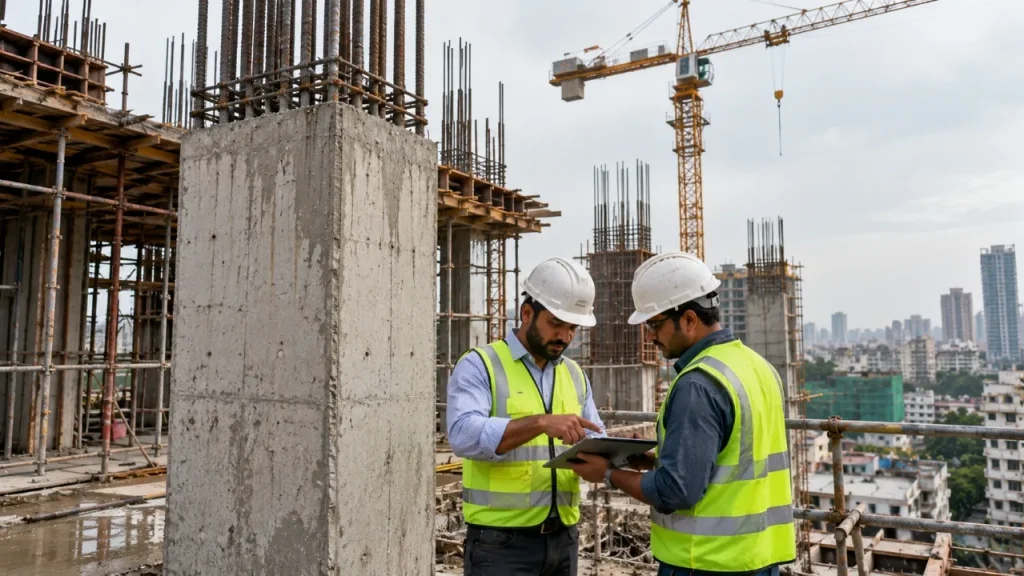
A high-rise is not a single application. Its foundations, columns, beams, slabs, and other elements face different structural and environmental demands.
The following table provides a general guide to the potential applications of Seven Rings Cement products. It is not a substitute for the project’s approved cement and concrete specifications.
| Product | Standard | Potential applications |
| Seven Rings Gold | CEM I, 52.5N | Prestressed elements, high early-strength concrete, and selected fast-track structural applications |
| Seven Rings Special | CEM II/A-M, 42.5N | High-rise buildings, RCC structures, columns, beams, slabs, and other demanding applications |
| Seven Rings Cement | CEM II/B-M, 42.5N | Residential and commercial construction, RCC structures, mass concreting, and underground structures |
| Seven Rings PPC | IS 1489 (Part 1):2015 | Specified applications requiring PPC, subject to export availability and verified technical suitability |
The structural engineer must determine the appropriate cement and concrete specifications based on loading, concrete grade, exposure conditions, construction methods, and applicable standards.
The Manufacturing Technology Behind the Performance
Product specifications on paper are only part of the picture. Manufacturing controls, quality assurance, raw-material consistency, and supply reliability also contribute to the delivery of cement that meets its specified requirements.
These factors become particularly important in high-rise construction, where concrete placement continues across multiple floors and construction phases.
Vertical Roller Mill Grinding
According to a feature published in Ceramic Bangladesh Magazine, Seven Rings Cement uses Vertical Roller Mills (VRM) and Ball Mills, with roller-press technology for specialized slag grinding.
The feature describes this combination of technologies as unique in Bangladesh.
VRM technology is an important part of modern cement manufacturing. It can support efficient grinding and controlled production, while the resulting cement characteristics depend on the raw materials, grinding parameters, and overall manufacturing process.
Cement fineness influences hydration and can affect concrete strength development and workability. VRM grinding produces finer and more uniform cement particles than conventional ball mill systems. Finer particles hydrate more completely, converting more clinker into strength-giving calcium silicate hydrate. A denser, more uniform paste also reduces the microscopic voids that allow moisture and chloride ingress.
However, fineness alone does not determine pumpability, permeability, or resistance to reinforcement corrosion. These properties depend on the cement, the complete concrete mix, curing, and construction quality.
In high-rise construction, the value of manufacturing technology lies in its contribution to controlled production and consistent product quality, supported by appropriate testing and quality assurance.
Independent Quality Verification
Seven Rings Cement reports evaluation and testing by national engineering institutions, including BUET, CUET, RUET, MIST, and IUT, as well as international testing bodies.
Independent testing can provide additional assurance that cement meets the relevant technical requirements. For structural applications, engineers and contractors should review the applicable product standards, current test reports, certifications, and project-specific acceptance criteria.
Quality verification should complement, rather than replace, appropriate concrete mix design, site testing, curing, and construction supervision.
Raw Material Supply Through Cemcoa
Seven Rings Cement is backed by Cemcoa, the raw-material trading arm of Shun Shing Group, recognized as Asia’s largest cement raw-materials trading network with 36 years of expertise.
Supply chain stability is rarely discussed in cement selection, but it is critical on high-rise projects. A building under construction at 15 or 20 stories cannot absorb batch-to-batch variation from inconsistent raw material sourcing.
Access to an established raw-material sourcing network can support procurement continuity and supply planning. This is relevant to high-rise construction, where interruptions in material availability can affect concrete placement schedules and overall project delivery.
Cemcoa’s position as the primary supplier keeps Seven Rings at the top of that priority chain.
The combination of raw-material sourcing capabilities and manufacturing operations can help support supply planning for projects that require substantial cement volumes over extended construction periods.
Proven on Bangladesh’s Most Demanding Projects
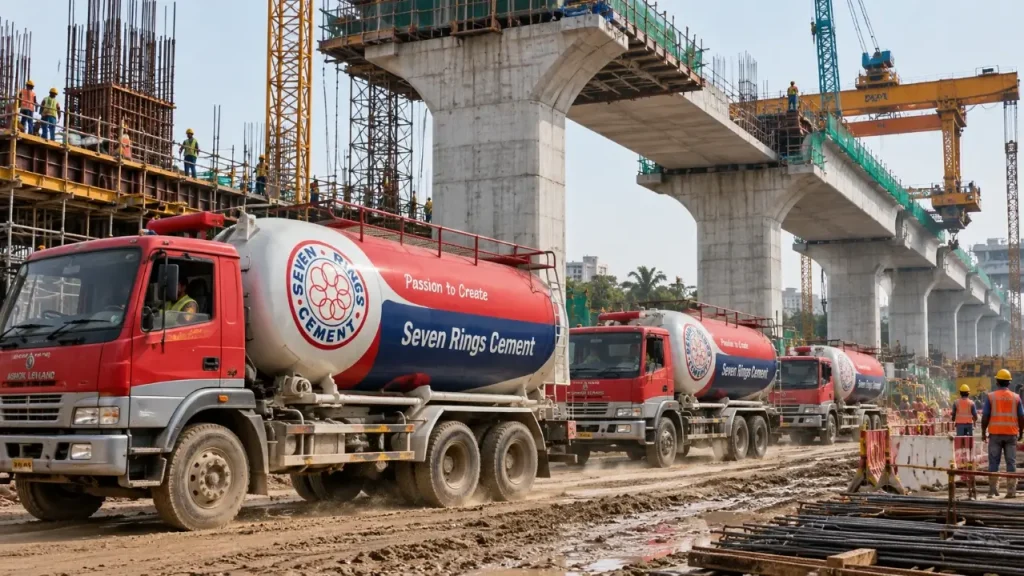
Let’s get real for a moment. Engineering specifications and product data sheets are useful. What actually builds confidence among structural engineers is a track record under real construction conditions, at scale.
Seven Rings Cement delivered over 0.370 million tons of cement to the Hazrat Shahjalal International Airport Third Terminal.
That is the highest quantity ever supplied by a single cement manufacturer to a single project in Bangladesh’s history. The terminal is a $1.8 billion infrastructure investment with engineering tolerances that leave no room for material inconsistency.
The brand has also supplied cement to the Padma Multipurpose Bridge and the Moghbazar-Mouchak Flyover. These are projects where the consequences of structural failure are national in scale.
Have you thought about what it actually means for a cement brand to supply at that scale, consistently?
A project of that magnitude requires hundreds of thousands of bags to achieve the same compressive strength, setting time, and workability, not in a single batch, but over months of continuous supply.
That demonstrated consistency is what engineers are actually buying when they specify a brand by name on a structural drawing.
Why Bangladesh’s High-Rise Boom Demands This Standard
Bangladesh’s urban development is increasing the importance of efficient land use and multi-story construction. In densely populated cities such as Dhaka, residential and commercial buildings must accommodate growing demand within limited urban space.
This context places greater emphasis on engineering design, construction supervision, material quality, and long-term durability.
A crack in a building may result from several factors, including structural design, concrete mix proportions, curing, reinforcement detailing, workmanship, and environmental exposure. Cement selection is one part of a broader system of measures required to achieve structural performance and durability.
The cement used in high-rise columns, transfer slabs, foundations, and structural walls must meet the requirements established by the project’s engineers. It must also be supported by suitable concrete mix designs, quality-control procedures, and consistent construction practices.
Seven Rings Cement offers different products for different technical requirements. Its manufacturing technologies, raw-material sourcing capabilities, reported independent testing, and documented involvement in major infrastructure projects provide relevant factors for engineers, developers, and contractors to evaluate.
The decision should ultimately be based on verified product performance, compliance with applicable standards, supply capability, and suitability for the project’s specific requirements.
Final Thoughts
High-rise construction in Bangladesh places increasing demands on every stage of the building process, from structural design and material selection to concrete placement and curing.
Cement choice is therefore more than a bag-by-bag purchasing decision. It is part of a broader specification that influences concrete strength development, workability, durability, and long-term structural performance.
Seven Rings Gold (CEM I, 52.5N) is designed for applications requiring high early strength, including prestressed concrete and selected fast-track construction projects.
Seven Rings Special (CEM II/A-M, 42.5N) offers a composite cement option for high-rise buildings and demanding RCC applications, subject to the specified concrete performance.
Seven Rings Cement (CEM II/B-M, 42.5N) serves a broad range of residential, commercial, RCC, and mass concreting applications.
Seven Rings PPC, produced for the Indian export market under IS 1489 (Part 1):2015, offers another option for projects whose requirements align with its verified technical characteristics.
Together, these products provide different options for construction professionals to evaluate against their project specifications.
The case for choosing Seven Rings Cement for high-rise building construction rests on its product range, manufacturing capabilities, quality-control processes, supply infrastructure, and documented participation in major projects. When supported by technical verification and appropriate engineering practices, these factors can contribute to informed cement selection for buildings designed to perform reliably over the long term.
Frequently Asked Questions (FAQs)
1. Which Seven Rings product is best suited for high-rise columns and beams?
Seven Rings Special (CEM II/A-M, 42.5N) is a product to consider for high-rise RCC structures, including columns, beams, and slabs. Its suitability depends on the required concrete grade, structural design, exposure conditions, and verified mix performance.
Seven Rings Gold (CEM I, 52.5N) is designed for applications requiring high early strength, such as prestressed concrete elements and selected fast-track construction work.
The final selection should follow the structural engineer’s specifications and relevant product test results.
2. Why do globally recognized tall buildings use composite cement rather than pure OPC?
Composite cement and blended concrete mixtures can offer advantages in long-term strength development, workability, heat management, and durability, depending on their composition and the concrete mix design.
The Burj Khalifa, for example, incorporated fly ash in its concrete mix for demanding structural applications. Such examples demonstrate how supplementary cementitious materials can contribute to high-performance concrete.
However, composite cement is not automatically superior for every application. The appropriate cement and concrete mix must be selected according to the project’s engineering requirements.
3. How does VRM grinding improve cement performance in high-rise concrete?
Vertical Roller Mill (VRM) technology is used in cement manufacturing to grind materials efficiently under controlled production conditions.
Cement fineness can influence hydration and strength development, but it does not independently determine concrete pumpability, permeability, or durability. These properties also depend on the concrete mix, aggregate grading, admixtures, curing, and construction practices.
For high-rise construction, manufacturing controls and product testing help establish whether the cement meets the specified requirements.
4. What compressive strength is typically required for high-rise structural concrete in Bangladesh?
Concrete grades such as C30 to C40 may be specified for many structural applications, but there is no single concrete grade that applies to every high-rise building.
The required compressive strength depends on the structural design, loading, building height, member dimensions, exposure conditions, and applicable standards. Specialized tall-building applications may require concrete strengths exceeding 80–100 MPa.
The structural engineer determines the required grade. Cement selection, concrete mix design, curing, and quality control must work together to achieve that specified strength.
5. Has Seven Rings Cement been verified on large-scale infrastructure projects in Bangladesh?
Seven Rings Cement supplied more than 0.370 million tonnes of cement to the Hazrat Shahjalal International Airport Third Terminal. The company also delivered cement to the Padma Multipurpose Bridge and the Moghbazar-Mouchak Flyover among its infrastructure projects.
These projects demonstrate the company’s reported involvement in large-scale construction. For any specific structural application, technical compliance and material performance should be evaluated through the relevant project records, product specifications, and quality-control documentation.

